
Phalaborwa Rare Earths Project and Local Stay Guide
Introduction
The Rainbow Rare Earths Phalaborwa Project in Limpopo is emerging as a globally significant source of rare earth elements (REEs) – especially those used for high-performance magnets in electric vehicles, wind turbines and defence technologies.
Located just outside the town of Phalaborwa, the project offers a unique intersection of mining, technology and tourism.
For those staying at Royal Game Guest House, this means business visitors, contractors, and investors coming to view the project, while also linking in with safari opportunities at nearby Kruger National Park.
This article explains the project in human-friendly terms, outlines the rare earth minerals involved, and shows why Royal Game Guest House is a strategic base for visitors.
Project Overview
The Phalaborwa Project is built on legacy phosphate processing waste – phosphogypsum stacks – rather than fresh open-pit mining.
According to Rainbow’s official data:
- A total JORC-compliant Mineral Resource Estimate of 35 million tonnes of phosphogypsum stacks at an average grade of 0.44% total rare earth oxides (TREO).
- About 29% of the contained rare earth oxides are the “magnet” rare earths (neodymium, praseodymium, dysprosium and terbium) – the high value elements.
- The process: hydraulic reclamation of the stacks combined with hydrometallurgical treatment and advanced separation (continuous ion-exchange / continuous ion-chromatography) rather than conventional mining-and-crush.
- Project life: Approximately 16 years at current throughput estimates (~2.2 Mt per annum) under the interim economics.
- Economic metrics: Base case net present value (NPV₁₀) of about US$611 million per the interim study.
By utilising an existing industrial waste stream rather than fresh mining, the project claims a lower-cost footprint and quicker ramp-up relative to traditional ore-body developments.
What Rare Earth Minerals Will It Mine?
The focus of the Phalaborwa Project is on the so-called magnet rare earth elements (MREEs). These are critical for today’s technology and the green energy transition. Here are the main ones involved:
Neodymium (Nd)
A key ingredient in neodymium-iron-boron (NdFeB) magnets. These magnets power electric vehicle motors, wind turbine generators, hard drives, robotics and precision industrial equipment.
Praseodymium (Pr)
Typically paired with neodymium (referred as NdPr) in magnet formulations. Adds strength and stability to the magnets, enhancing efficiency in demanding applications.
Dysprosium (Dy)
Used in smaller amounts, but crucial when high-temperature stability is required (such as in EV motors, offshore wind turbines).
Terbium (Tb)
Even smaller volumes, but high value: enhances magnet performance in extreme conditions and specialised technologies.
Rainbow’s plan is to deliver separated rare earth oxides of Nd/Pr, Dy and Tb with high purity (target >99%) directly at the Phalaborwa site rather than exporting mixed concentrates. (Mining Weekly)
Other rare earths (such as samarium, europium, gadolinium, cerium, lanthanum) may be recovered as by-products, but they are secondary in terms of project economics. (Mining Weekly)
How the Project Works – Step by Step
1. Feed material: Phosphogypsum stacks
Rather than digging a new mine, the project reclaims existing phosphogypsum stacks left from historic phosphate acid production. These stacks contain dispersed rare earths. (miningdataonline.com)
2. Reclamation & transportation
Hydraulic methods are used to reclaim the gypsum-rich material from the stacks, slurry it to a processing facility onsite.
3. Hydrometallurgical leaching and upgrading
Using acid leaching, washing and other treatment, the rare earths are dissolved and upgraded to a high-grade feed. According to recent updates, the process flowsheet has been simplified and optimised to maintain recovery rates near ~66%. (Mining Weekly)
4. Separation & purification
The high-grade feed is processed through continuous ion-exchange (CIX) and continuous ion-chromatography (CIC) to separate Nd, Pr, Dy and Tb into high-purity oxides. A recent pilot achieved Nd/Pr oxide at ~96% purity. (Research Tree)
5. Clean gypsum and water management
Processed gypsum may be redeposited or sold for other uses. Water and chemicals are managed in closed systems to reduce environmental footprint. (Rainbow Rare Earths)
6. Production and export
Once full-scale, the site is expected to produce around 1,865–1,900 t per annum of magnet rare earth oxides. (Rainbow Rare Earths)
Strategic and Local Benefits
Global significance
The rare earth supply chain is under pressure worldwide. Much of the mining and processing is concentrated in China.
Phalaborwa offers a non-Chinese, lower-cost, potentially cleaner source of magnet rare earths – aligning with global interests in clean energy, defence and technology supply-chain independence. (TechMet Ltd)
Regional/local benefits
For Phalaborwa and the surrounding Ba-Phalaborwa district:
- Skilled and semi-skilled jobs during construction and ongoing operations: processing, lab work, logistics, environmental monitoring. (Mining Weekly)
- Demand for local supply-chain services: civil contractors, equipment maintenance, transport, catering and hospitality.
- Increased business travel into Phalaborwa for site visits, consultants, investors and off-take partners.
- Tourism-business link: Guests staying in town can combine project-related business with safari experiences in Kruger.
Why Royal Game Guest House is an Ideal Base
For executives, engineers, investors or consultants visiting the Phalaborwa site, Royal Game Guest House offers a strategic blend of convenience and comfort:
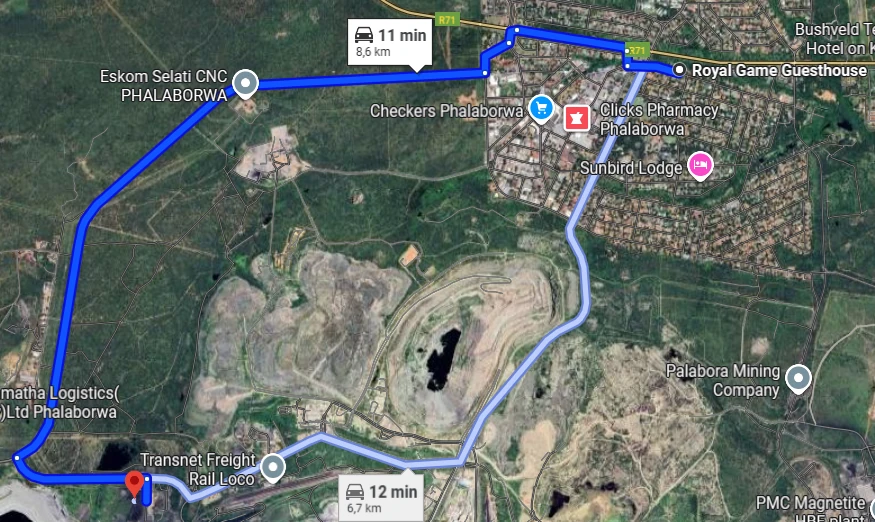
- Proximity: Located in Phalaborwa, within easy drive of the mining complex and close to the Kruger’s Phalaborwa Gate – convenient for business plus leisure.
- Business-ready amenities: Quiet rooms, reliable connectivity (essential for evening video calls or report writing), secure parking for vehicles, easy access for rental fleet or bakkies.
- Bleisure potential: After a day of site meetings or processing reviews, guests can shift into safari mode with a game drive into Kruger or riverside relaxation – offering balance and wellness.
- Local insight: The guest house can position itself as the go-to accommodation for “Phalaborwa Rare Earths Project visitors”, “business accommodation near the Phalaborwa Mining Complex” or “visitor stay for Rainbow Rare Earths site visits” – capturing search demand from corporate travellers, investors and analysts.
FAQ – Frequently Asked Questions
Q1: What exactly is the Phalaborwa Rare Earths Project?
A1: It is a development by Rainbow Rare Earths to recover rare earth elements from phosphogypsum stacks (waste from phosphate processing) located near Phalaborwa, Limpopo. The aim is to produce magnet rare earth oxides (neodymium, praseodymium, dysprosium, terbium) via a hydrometallurgical plant with low mining footprint.
Q2: How long will the project run and what is the scale?
A2: Current modelling gives a project life of about 16 years at ~2.2 million tonnes per annum processing rate. The JORC resource is approximately 35 million tonnes of material at 0.44% TREO.
Q3: What is the benefit of recovering rare earths from stacks rather than mining new ore?
A3: Because the feed material is already on surface and chemically easier to process, the project avoids large scale blasting, crushing, milling and the high capex and environmental burden of a new open pit mine. This reduces cost, risk and time to production.
Q4: Which rare earths are most important for the project?
A4: The primary focus is on magnet-grade rare earths: neodymium (Nd), praseodymium (Pr), dysprosium (Dy) and terbium (Tb). These are the high-value elements used in high-performance magnets.
Q5: Can someone visiting Phalaborwa stay near the project site?
A5: Yes. Royal Game Guest House in Phalaborwa provides an excellent base for visitors to the project. It is conveniently located for site visits, offers business-friendly amenities and is close to safari opportunities in Kruger National Park.
Q6: What is the local impact for Phalaborwa and the region?
A6: The project is expected to create jobs (skilled and semi-skilled), stimulate local services (contractors, hospitality, transport) and bring sustained business travel into the region – thereby boosting the local economy.
Q7: Is there any environmental advantage?
A7: Yes. By re-using and processing legacy phosphogypsum waste, the project avoids new land disturbance and large-scale mining. The process also implements advanced separation technology and water/gypsum management systems to reduce environmental impact.
Q8: When is production expected to start?
A8: Reports suggest the project could move into full development in the mid-2020s once the Definitive Feasibility Study (DFS) is finalised and financing secured. (proactiveinvestors.com)
Conclusion
The Phalaborwa Rare Earths Project represents a strategic and regionally significant mining-processing development in South Africa.
For stakeholders in the magnet rare earth supply chain it offers a new, lower-cost source of critical elements.
For the local region, including Phalaborwa and hospitality providers such as Royal Game Guest House, it means steady business travel, investment interest, and growth potential.